Training Is Never Wasted

Every domain of excellence shares a common foundation: training. The athlete who wins a championship trained long before anyone was watching. The surgeon who performs a flawless procedure trained for years before ever holding a scalpel in an operating room. And the believer who walks in consistent spiritual power trained in the secret place long before the public moment arrived. Training is never wasted. It is always building something.

The Principles Transfer Across Every Domain

What is remarkable about foundational training principles is that they are not limited to one area of life. The commitment required to build a healthy body is the same commitment required to build a healthy prayer life. The discipline to study a craft until mastery arrives mirrors the discipline of studying the Word until revelation becomes second nature. Consistency, repetition, progressive challenge, and recovery are patterns that God wove into the fabric of growth itself.

This means that what you learn in one area of diligence can strengthen another. The person who trains their body learns something about persistence that their spirit can use. The person who develops their mind in study learns something about focus that their physical conditioning can benefit from. Growth is integrated. You are not a collection of separate compartments. You are one person, and training in any dimension of your life touches all the others.

Foundation Before Function

One of the great mistakes in any domain is rushing to function before establishing foundation. People want to perform before they have prepared. They want the platform before they have built the character to sustain it. But every structure that lasts was built on a foundation that was laid carefully, often invisibly, and without applause.

Jesus trained for thirty years before three years of public ministry. Paul spent years in Arabia after his encounter with Christ before his missionary journeys began. Foundation is not delay. Foundation is investment. What is built slowly and deeply lasts. What is rushed and shallow falls.

Stay in the Process

Wherever you are in your training, whether spiritual, physical, professional, or relational, stay in it. The season of preparation is not the enemy of your destiny. It is the construction zone of it. God is forming something in you through the repetition, the resistance, and the refinement that only a committed training process can produce.

Trust the process. The results are already taking shape.

-Terrence Burton

You Already Have What You Need: Unlocking the Power of Time, Talent, and Tools

Have you ever looked at your life and felt like you were missing something? Maybe you told yourself, “If I just had more time…” or “If I only had the right connections…” or “If I were more gifted…” The truth is, God has already placed in your hands the three most powerful resources available to any person: time, talent, and tools. The question is never whether you have enough — it is whether you are using what you already hold.

Time: The Great Equalizer

Every human being on earth receives the same 24 hours in a day. Time does not favor the rich over the poor, the educated over the unschooled, or the experienced over the beginner. What separates people who grow from people who stagnate is not the quantity of time they possess, it is the quality of how they invest it. Time is the one resource God has distributed with absolute equity. When you choose to use it for prayer, study, service, and intentional growth, time becomes a powerful agent of transformation. Even without great talent or sophisticated tools, a person who disciplines their time will make meaningful progress. Proverbs 21:5 tells us that “the plans of the diligent lead to profit.” Diligence is not genius, it is faithful use of the time you already have.

Talent: Your God-Given Capacity

Talents are not just artistic abilities or performance gifts. Your talent is any innate or developed capacity that allows you to think, create, lead, solve problems, and serve others with excellence. Talents grow through use and shrink through neglect. The parable of the talents in Matthew 25 makes this unmistakably clear: the servants who put their gifts to work received more, while the one who buried his received nothing. God does not give you talent so it can sit dormant waiting for perfect conditions. He gives it so you can invest it in your family, your community, your calling, and His kingdom. Raw ability, even in difficult circumstances, can shine and make an eternal difference.

Tools: The Multipliers in Your Hands

Tools are the external resources God places around you to extend what you can do alone. They include technology, books, relationships, systems, strategies, and even daily routines that help you apply your talent more effectively over time. Too often believers overlook the tools right in front of them because they are looking for something more dramatic. But the shepherd boy David had a sling. The widow in 2 Kings 4 had a jar of oil. Gideon had 300 men and torches. God consistently uses ordinary tools in consecrated hands to produce extraordinary results.

The real power emerges when all three align. Time develops talent. Talent multiplies the value of time. Tools enhance both. When you bring these three together under the leadership of the Holy Spirit, you become a force that cannot easily be stopped. Stop waiting for conditions to be perfect. Start with what is in your hands — your hours, your gifts, and the resources around you. God will meet your faithfulness with His multiplication.

-Terrence Burton

Pressing Toward the Mark

Spiritual growth is rarely, if ever accidental. Scripture presents it as a deliberate pursuit—steady, focused, and forward-looking. The Christian life is not described as standing still, but as moving toward something God has already set ahead.

Paul writes with striking clarity: “This one thing I do, forgetting those things which are behind, and reaching forth unto those things which are before” (Philippians 3:13 KJV). His language is active and intentional. The past—whether success or failure—is not allowed to govern the present. Growth requires release. To press forward means to refuse to be anchored by what God has already addressed or accomplished. Paul’s focus is singular, not scattered.

He continues, “I press toward the mark for the prize of the high calling of God in Christ Jesus” (Philippians 3:14 KJV). The “mark” is direction, not destination. It represents alignment with God’s calling rather than personal comfort. The prize is not earthly recognition but participation in God’s purpose. This pursuit is echoed elsewhere when Paul urges believers to “run, that ye may obtain” (1 Corinthians 9:24 KJV). Effort does not replace grace—it responds to it.

Hebrews uses similar imagery, calling believers to “run with patience the race that is set before us” (Hebrews 12:1 KJV). The race is set—assigned by God, not chosen at random. Patience is required because progress is often slower than expectation. The passage also reminds us to lay aside weights, not only sins. Anything that slows forward motion, even if lawful, can hinder growth.

Pressing forward is sustained by hope. Paul tells the Romans that “hope maketh not ashamed” (Romans 5:5 KJV). Hope provides endurance, especially when the finish line feels distant. It keeps the believer oriented toward what God is doing, not merely what is happening. Forward movement, in Scripture, is rarely dramatic—but it is always faithful.

To press toward the mark is to live with direction, discipline, and expectation. It is not driven by perfection, but by perseverance.

Takeaway: Spiritual maturity grows when the heart stays focused on where God is leading, not where it has been.

Guarding Your Heart

The inner life quietly shapes every outward step. Scripture teaches that the heart is the wellspring of thoughts, decisions, and desires, making it the true battleground of spiritual stability. To guard the heart is to protect what governs the entire course of life.

Proverbs offers the central call: “Keep thy heart with all diligence; for out of it are the issues of life” (Proverbs 4:23). The word keep suggests watchfulness—an attentive guarding similar to a city sentinel. What enters the heart eventually grows roots, shaping responses long before a moment of pressure arrives. This makes diligence essential, not optional.

The psalmist understood this deeply, praying, “Create in me a clean heart, O God; and renew a right spirit within me” (Psalm 51:10). Guarding the heart requires more than human discipline; it requires divine renewal. When David prayed for a clean heart, he wasn’t asking for a surface adjustment but a complete realignment of his inner life. His words remind us that guarding and cleansing are intertwined.

Jesus also highlighted the heart’s central role in shaping words and actions. He said, “A good man out of the good treasure of the heart bringeth forth good things” (Matthew 12:35). What we treasure—what we allow to settle and dwell within—eventually becomes visible. Likewise, Paul counseled believers to let “the peace of God rule in your hearts” (Colossians 3:15), showing that the guarded heart is not tense but anchored, ruled by peace rather than turmoil.

Guarding the heart is not isolation from the world but alignment with God. It is the daily choice to protect the inner life from corrosive influences and to fill it with truth, peace, and righteousness. What is cultivated within becomes strength without.

Takeaway: A guarded heart becomes a steady life, shaped by truth, renewed by God, and anchored in peace.

— Terrence Burton

The Watchman’s Call

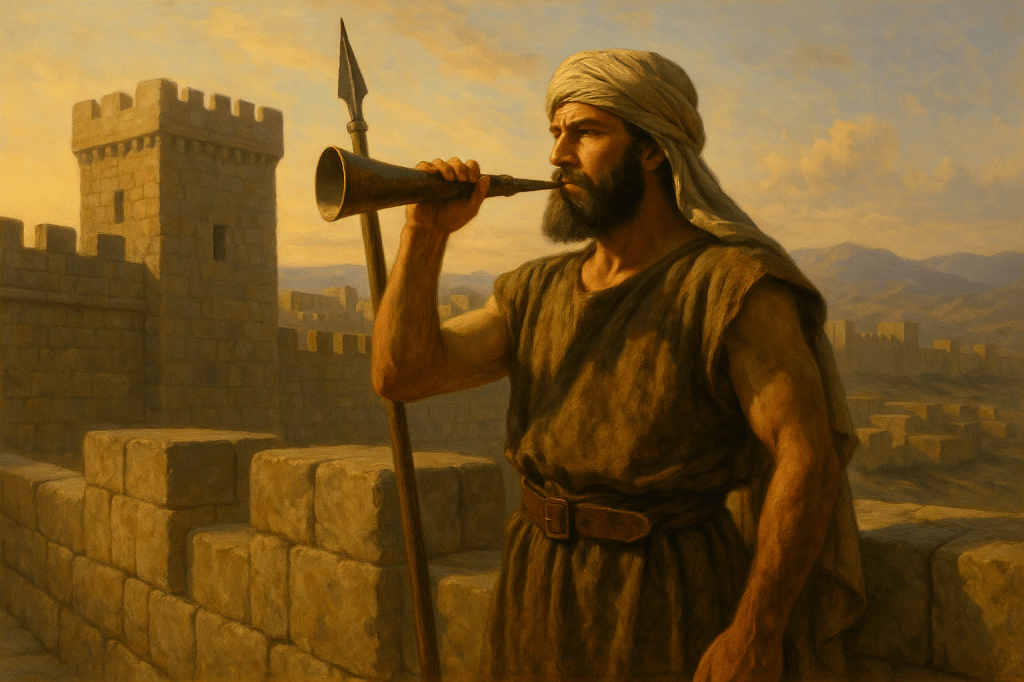
A watchman lives with alertness woven into his purpose. Scripture uses this image to describe those who stay spiritually awake, attentive to God’s Word, and responsive to His warnings. The prophetic writings remind us that vigilance is not fear-driven—it is faithful stewardship of what God reveals.

Ezekiel received one of the clearest pictures of this role. God told him, “Son of man, I have made thee a watchman unto the house of Israel” (Ezekiel 3:17). A watchman doesn’t control the horizon; he simply stays awake to it. The call is to hear the word at God’s mouth and give warning when needed. This responsibility highlights the seriousness of responding to God’s truth—silence can harm, but faithful speech preserves.

Isaiah adds another layer, showing that watchmen also look for God’s movements, not only danger. “Thy watchmen shall lift up the voice… for they shall see eye to eye, when the LORD shall bring again Zion” (Isaiah 52:8). Here the watchmen rejoice as God restores His people. Spiritual vigilance includes recognizing moments of God’s mercy and redemption, celebrating His work rather than merely scanning for trouble.

Habakkuk echoes this posture of expectancy: “I will stand upon my watch… and will watch to see what he will say unto me” (Habakkuk 2:1). He waits—not with impatience, but with disciplined attentiveness. In times of uncertainty, the watchman’s stance becomes a symbol of trust. God’s reply assures him that the vision will come in its appointed time, and that the just shall live by faith (Habakkuk 2:3–4).

Takeaway: A watchman’s strength is steady attentiveness—he listens, waits, and responds to God with faithful clarity.

-Terrence Burton